Plant Prefab Site Prep & Utilities: The Fort Worth Owner’s Guide
Site prep and utility work for a Plant Prefab unit in Fort Worth typically runs $18,000 – $52,000 depending on your lot, soil conditions, and how far utilities need to run from the street. We stock the components needed for this work and can usually get boots on your lot within a week of your initial call. Most owners discover a site prep or utility problem the hard way: the excavation crew shows up, hits limestone ledge four feet down, and suddenly the original foundation estimate doesn’t hold. Or worse, the water line stubbed in during rough-in was never pressure-tested, and now there’s a wet spot forming between the ADU and the house.
Which Plant Prefab Models This Applies To
Plant Prefab’s product line has shifted over the years, and site prep requirements differ between their panelized systems and their factory-built modules. The original Koto and LivingHomes series sit on either a conventional perimeter foundation or a slab-on-grade, and the utility stub-in points are fixed at the factory. Their newer factory-built units arrive with utility connection points marked in the installation manual, and that manual is your best friend when planning trenching. Here’s what matters for compatibility: measure the location of your water, sewer, and electrical stub-outs from the unit’s corners before any trenching gets bid. A stub-out that’s off by 18 inches can add $2,000+ in rework when the delivery truck is already unloaded in your driveway. For Plant Prefab specifically, OEM-labeled site prep components don’t really exist as a separate buy; the factory delivers the structure, and the foundation, utilities, and connections are site-built. That means you’re choosing a contractor’s work, not a brand-name part. Our take after working with these units: quality aftermarket materials, properly installed, match or beat anything factory-specified for Texas soil conditions.
Signs Your Plant Prefab Site Prep & Utilities Is Failing
- Water pooling near the slab edge after rain. This usually means the final grade wasn’t sloped away correctly, or the downspout extensions were never installed. In Fort Worth’s clay-heavy soils, standing water against a slab will cause heave within two seasons.
- Low water pressure at fixtures when the main house is fine. Undersized supply piping or a crushed line during backfill is the typical culprit. We see this most often when the trench was backfilled with the same rocky soil that came out of it.
- Sewer gurgling or slow drains in the ADU. The waste line was likely run with insufficient slope, or tree roots have already found a joint. North Texas clay shifts enough that glued PVC joints can separate within five years if the trench bedding wasn’t compacted properly.
- Breaker trips when the mini-split or range kicks on. The electrical feeder from the main panel may be undersized for the unit’s actual draw. Plant Prefab units built for California often spec electrical loads that don’t match what Texas summer air conditioning actually demands.
- Cracks appearing in the slab or at the stem wall corners. This is the one to take seriously. It often means the pad wasn’t engineered for the soil’s plasticity index, and the clay is doing what wet Texas clay does: expanding and contracting against your foundation.
Replacement Cost & What’s Included
For a full site prep and utility package in Fort Worth, plan on $18,000 – $52,000. That range covers the spread between a flat suburban lot with short utility runs and a tighter infill lot in neighborhoods like Ryan Place or near the TCU campus where trenching is longer, fencing has to come down, and the city’s right-of-way bond adds a line item. A partial repair, like re-running a water line or adding a pressure regulator, typically lands between $2,400 and $7,500. Every quote from Sutton ADU Fort Worth includes the line-item breakdown: excavation hours, materials, utility connection fees, backfill and compaction, and final grade. You get that written price before we move dirt. The 365-Day Done Right Promise covers defects in workmanship for one full calendar year from project completion, and if a utility connection fails in that window, the second visit is free.
DIY or Call Us?
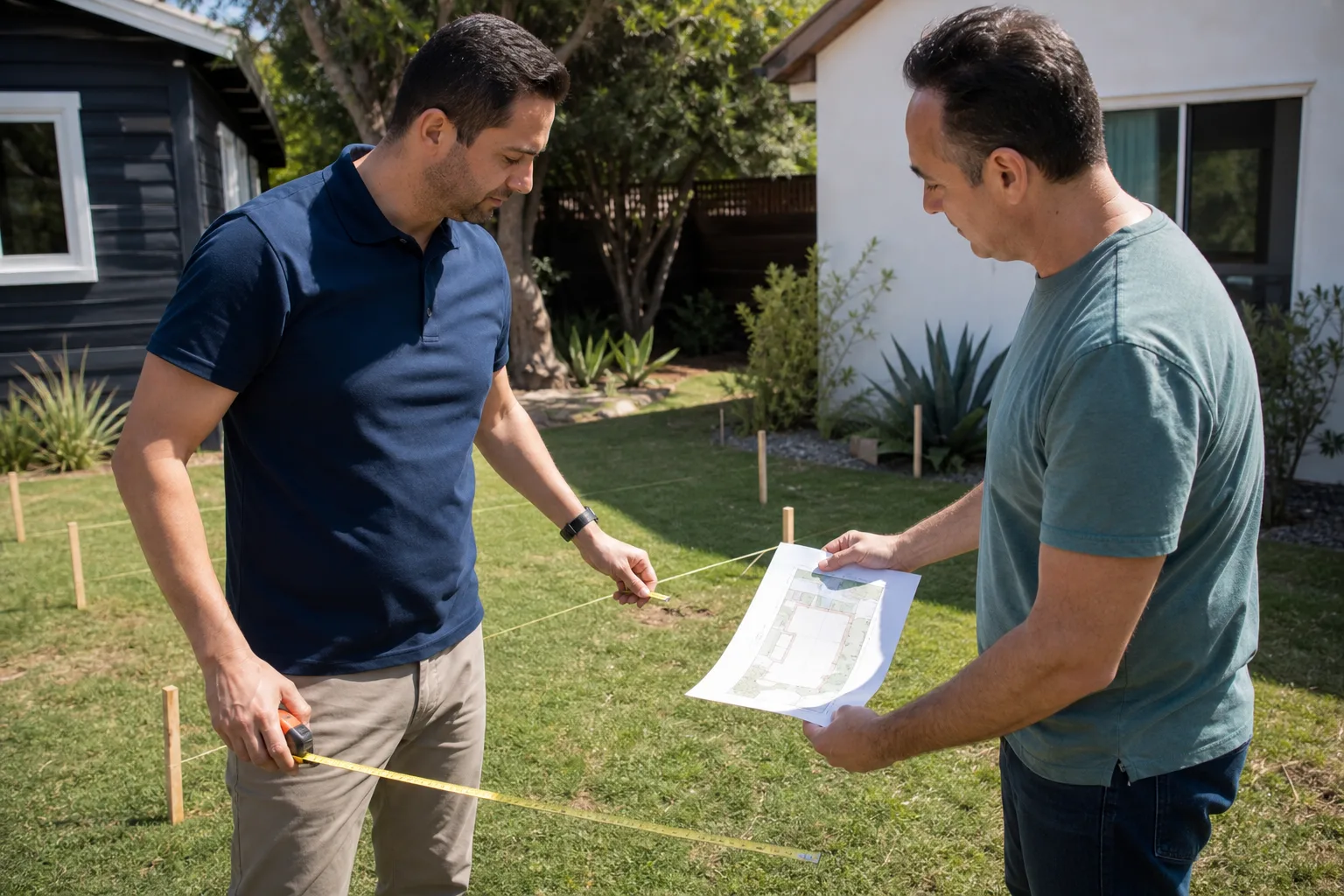
There are things you can check yourself: confirm your main shut-off valve for the ADU actually works, verify downspouts are extended at least four feet from the slab, and check whether the breaker serving the ADU is sized per the installation manual. Beyond that, site prep and utility work is not a DIY proposition. Trenching carries a real risk of hitting existing gas or electrical lines, and Fort Worth requires permits and inspections for utility connections. High-voltage feeder connections to a subpanel are genuinely dangerous if done wrong. That’s not a scare tac, that’s the plain truth. If you suspect a utility problem or you’re planning a Plant Prefab delivery and the site isn’t ready, call (682) 255-2399. We’ll walk the lot with you first.
FAQs
A properly engineered foundation and utility installation should last 50+ years, but the weak points in Fort Worth are the soil conditions and the quality of the original backfill. We’ve been called to repair utility lines that failed within four years of installation, and the cause is almost always rushed compaction or undersized trench bedding. Call (682) 255-2399 if you want a site assessment before problems show up.
Utility problems are repairable without touching the foundation in most cases. Foundation problems are a different story: slab heave on North Texas clay sometimes requires piers, and that’s a separate engineering discussion. The first step is a site visit to identify exactly what’s failing and why. Estimates are free.
A full package for a Plant Prefab ADU typically takes 3 – 6 weeks from first excavation to final inspection, depending on Fort Worth’s permit queue and weather. Partial utility repairs can often be done in 2 – 4 days. We’ll give you a calendar timeline with the written estimate, no vague “soon” answers.
We stock the materials that matter for this work in Fort Worth: schedule 40 and schedule 80 PVC, PEX supply line, conduit and feeder wire, water service components, and compaction equipment. Plant Prefab units don’t require proprietary utility parts, so what we carry covers the installation and repair of every connection point these units come with. If you need a part matched to an Abodu, Cover, or Dvele unit, we handle those as well.
Written by Miles Hartwell, Owner, Sutton ADU Fort Worth at Sutton ADU Fort Worth, serving Fort Worth and nearby areas.